
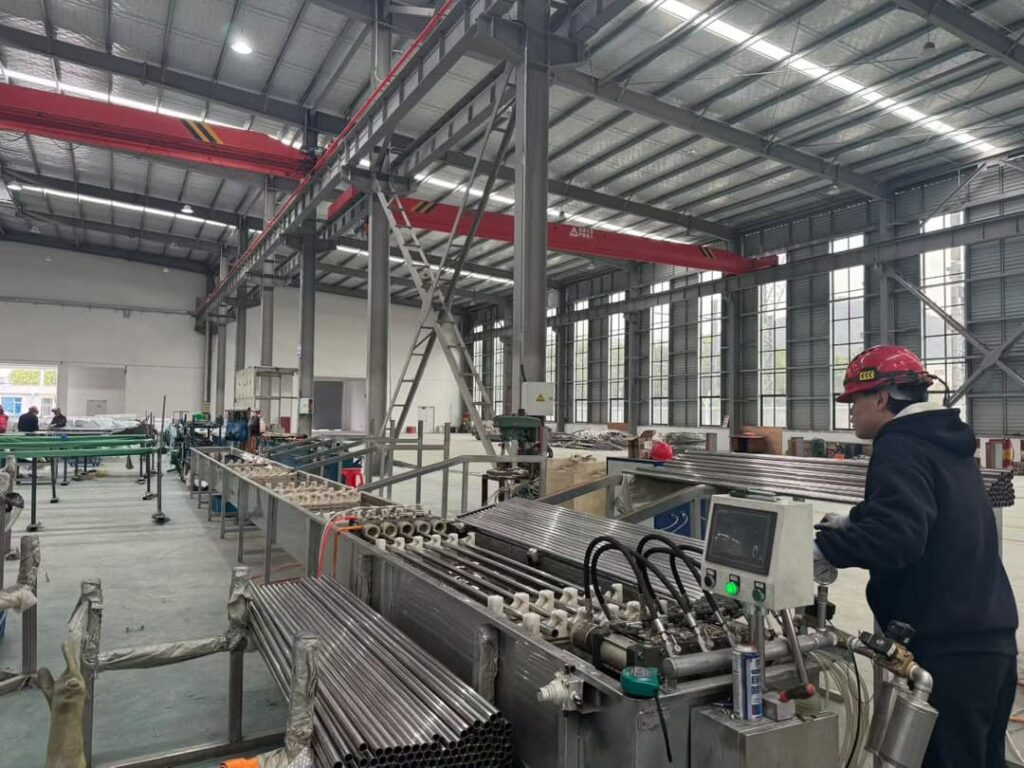
Overview
Stainless steel tubes are widely used in demanding industries including chemical processing, oil & gas, heat exchangers, food processing, pharmaceuticals, medical equipment, marine engineering, and construction.
The manufacturing process of stainless steel tubes requires strict control from raw material selection to final inspection to ensure excellent corrosion resistance, dimensional accuracy, mechanical properties, and surface quality.
At Yunming Metal, we manufacture and supply seamless stainless steel tubes y welded stainless steel tubes according to international standards such as ASTM A312, ASTM A213, ASTM A269, and EN standards.
With advanced production processes and strict quality control, our stainless steel tubes are suitable for both standard applications and customized engineering projects.
Stainless Steel Tube Manufacturing Process
The manufacturing process varies depending on whether the tube is seamless or welded. Generally, production includes raw material preparation, forming, heat treatment, surface treatment, inspection, and final packaging.
The main manufacturing steps include:
- Selección de materias primas
- Tube Forming Process
- Tratamiento térmico
- Straightening and Sizing
- Acabado de superficies
- Inspection and Testing
- Cutting and Packaging
1. Raw Material Selection
High-quality stainless steel raw materials are the foundation of reliable tube performance.
Common stainless steel grades include:
- 304 / 304L Stainless Steel
- 316 / 316L Stainless Steel
- 321 Stainless Steel
- 310S Stainless Steel
- Duplex Stainless Steel 2205
- Super Duplex Stainless Steel 2507
- Acero inoxidable 904L
Before production, raw materials are checked for:
- Chemical composition
- Material grade
- Surface condition
- Heat number traceability
Material certificates such as EN10204 3.1 Mill Test Certificates (MTC) can be provided according to customer requirements.
2. Seamless Stainless Steel Tube Manufacturing Process
Seamless stainless steel tubes are produced without welding joints, providing excellent strength and pressure resistance.
Step 1: Tube Blank Preparation
Round stainless steel billets are selected according to the required tube dimensions.
The billets are inspected and prepared before hot extrusion or piercing.
Step 2: Hot Piercing / Extrusion
The heated billet is pierced to create a hollow tube shell.
This process forms the initial tube shape while maintaining uniform wall thickness.
Step 3: Cold Drawing
Cold drawing reduces tube diameter and wall thickness while improving:
- Dimensional accuracy
- Surface finish
- Mechanical properties
Multiple drawing processes may be required for precision tubes and small diameter tubes.
Step 4: Heat Treatment
Heat treatment restores material properties after cold working.
Typical processes include:
- Recocido en solución
- Stress relieving
This improves:
- Corrosion resistance
- Ductility
- Metallurgical structure
3. Welded Stainless Steel Tube Manufacturing Process
Welded stainless steel tubes are produced by forming stainless steel strips or sheets into tubular shapes and joining the edges through welding.
Step 1: Stainless Steel Strip Preparation
Stainless steel coils are cut into strips according to tube size requirements.
Step 2: Tube Forming
The strip passes through forming rollers and gradually changes into a round tube shape.
Step 3: Welding
The tube edges are joined through welding processes such as:
- TIG welding
- Laser welding
- High-frequency welding
The weld area is carefully controlled to ensure strength and appearance.
Step 4: Weld Treatment
After welding, the tube may undergo:
- Weld bead removal
- Tratamiento térmico
- Pickling
- Polishing
to improve corrosion resistance and surface quality.
4. Tube Sizing and Straightening
After forming and heat treatment, stainless steel tubes undergo sizing and straightening processes.
These processes ensure:
- Accurate outside diameter
- Uniform wall thickness
- Straightness
- Consistent dimensions
Final dimensions are checked according to customer specifications and international standards.
5. Stainless Steel Tube Surface Finishing
Surface treatment is an important step for stainless steel tube performance and appearance.
Common finishes include:
Annealed & Pickled Surface
Provides excellent corrosion resistance and is widely used for:
- Chemical industry
- Oil & gas
- Industrial piping
Polished Surface
Used where smooth appearance and easy cleaning are required.
Las aplicaciones incluyen:
- Food processing
- Pharmaceutical equipment
- Decorative applications
Bright Annealed (BA) Surface
Provides a smooth and reflective surface for high cleanliness applications.
Brushed / Satin Finish
Commonly used for:
- Handrail systems
- Architectural projects
- Decorative tubes
6. Stainless Steel Tube Inspection and Testing
Quality inspection is performed throughout the manufacturing process.
Typical inspection includes:
Chemical Composition Testing
Ensures the material meets specified stainless steel grades.
Mechanical Testing
Including:
- Tensile test
- Yield strength test
- Elongation test
Dimensional Inspection
Checks:
- Outside diameter
- Wall thickness
- Longitud
- Straightness
Non-Destructive Testing (NDT)
Depending on requirements:
- Eddy Current Testing
- Hydrostatic Testing
- Ultrasonic Testing
Surface Inspection
Checks surface defects, scratches, and finishing quality.
7. Cutting, Packing and Delivery
Before shipment, stainless steel tubes are:
- Cut to required lengths
- Marked according to customer requirements
- Packed with suitable protection
Export packing options include:
- Wooden cases
- Steel frames
- Bundles with waterproof protection
Yunming Metal provides professional export packing to ensure products arrive safely at customers’ destinations.
Stainless Steel Tube Manufacturing Standards
Our stainless steel tubes can be manufactured according to international standards including:
| Estándar | Aplicación |
|---|---|
| ASTM A312 | Seamless and welded stainless steel pipe |
| ASTM A213 | Heat exchanger and boiler tubes |
| ASTM A269 | General service stainless steel tubing |
| ASTM A270 | Sanitary stainless steel tubes |
| EN 10217 | Welded steel tubes |
| EN 10216 | Seamless steel tubes |
Why Choose Yunming Metal for Stainless Steel Tubes?
Reliable Material Control
We maintain full traceability from raw material to finished products.
Wide Range of Stainless Steel Grades
Available materials include:
304, 316L, Duplex 2205, Super Duplex 2507, 904L and other special alloys.
Customized Tube Solutions
We support customized requirements including:
- Special dimensions
- Precision tubes
- Capillary tubes
- U-bend tubes
- Decorative tubes
Strict Quality Inspection
Each production stage is controlled to meet customer requirements and international standards.
Applications of Stainless Steel Tubes
Our stainless steel tubes are widely used in:
- Heat Exchangers
- Procesado químico
- Pharmaceutical Equipment
- Food Processing Systems
- Oil & Gas Projects
- Ingeniería naval
- Water Treatment
- Construction Projects
- Equipos médicos
Preguntas más frecuentes (FAQ)
What is the difference between seamless and welded stainless steel tubes?
Seamless tubes are manufactured without welding joints and are suitable for high-pressure and critical applications. Welded tubes are produced by welding stainless steel strips and are widely used for general industrial applications.
What stainless steel grades can be produced?
Common grades include 304, 316L, 321, 310S, Duplex 2205, Super Duplex 2507, and 904L.
Can you provide material certificates?
Yes. Material certificates such as EN10204 3.1 MTC can be provided according to customer requirements.
What surface finishes are available?
We can provide annealed & pickled, polished, bright annealed, brushed, and customized surface finishes.
Contact Yunming Metal
Yunming Metal specializes in manufacturing and supplying stainless steel tubes, pipes, and related stainless steel products for global industrial applications.
From standard stainless steel tubes to customized precision solutions, we provide reliable quality, competitive pricing, and professional service.
Contact us for your stainless steel tube requirements.